ISSUES POSITION PAPERS
Petter Holm Norwegian College of Fishery Science Breivika, N-9037 Tromso, Norway
Fisheries Resource
Management as a Heterogeneous Network
Introduction
In a conversation with Tony Davis recently, I claimed that fisheries economists, since they are so successful in turning their theoretical models into practical reality in the case of ITQs must be better sociologists than, say, Svein Jentoft, whose propagation for the virtues of a co-management model is largely ignored. Tony thought I was joking. I was not. This is an attempt to explain my position and make sense of the apparently preposterous propositions it leads to. This position is based on an analysis of science and scientific knowledge that goes under the name of Actor Network Theory (ANT) and has been developed by Bruno Latour, Michel Callon and John Law. It is, to say the least, an extremely provocative and controversial perspective. A full presentation is impossible in this context, of course, and you will have to evaluate it largely by the insights and recommendations it generates when it comes to how one should construct a viable fisheries resource management alternative, as suggested below. Before I start, however, I must say a little bit about how ANT looks at the natural and social sciences, and where, it positions itself in relation to them.
Actor Network Theory
According to ANT the separation and contrast between Nature and Society is of great significance in modern western science. Thus, the natural sciences typically are oriented towards the Nature pole under the mantle of materialism, rationalism, and natural realism, while social scientists are drawn towards the Society pole, dressed up as idealists, constructivists, and social realists. The point now is that scientists of different persuation not simply and neatly find their place somewhere along this stretch, but that they collectively and continuously invent and reinvent it, and continue to move its poles further and further apart. This process, in which Nature and Society are constantly invented as opposed to and completely separate from each other, is called, within ANT, the work of purification. The work of purification ascribes all existents to two entirely distinct ontological zones, that of nonhumans and humans, things and subjects. Within modernity, says ANT, existents only are acknowledged as real to the extent that they can be referred back to their pure form, as either emenating from Nature or Society (Latour, 1993).
However, the practice of purification presupposes another practice, namely that of translation, which mixes nature and culture and creates 'hybrids', 'monsters', or 'heterogeneous networks', in short, blends together what the work of purification pries apart. This means that Latour adds a second dichotomy to the one between Nature and Society (Figure 1).
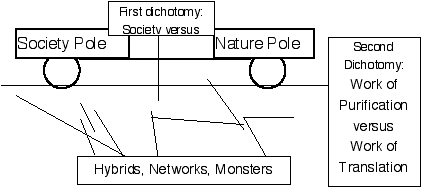
Figure 1: Purification and translation (Adapted from Latour, 1993, Figure 1.1. Page 11)
According to ANT, then, reality consists of monsters or heterogeneous networks, mixes of all different sorts of entities and materials, be it physical, human, symbolic and textual. Within the modern constitution, however, such mixes are acknowledge as real only to the extent they can be referred back to their pure form, as either part of Nature or Society. The work of purification is the task of conventional sciences. The natural sciences are preoccupied with taking the hybrids apart and understand them as pure Nature. The social sciences want to take the hybrids apart and explain them as pure Society. In contrast, ANT rejects both forms of purification. Nevertheless, the invention of Society and Nature during purification processes must be seen as part of the work of translation; of making, extending and stabilizing networks. However, within ANT we cannot import such distinctions as a priori preconditions into the analysis and use them as explanatory resources. On the contrary, the establishment of such distinctions and their acceptance as 'real' are (part of) what we want to study. So, in contrast to the conventional sciences, which are engaged in the process of purification, ANT wants to understand translation processes. ANT accepts that reality is composed of heterogeneous networks and does not try to reduce it to some pure form, be it natural or societal.
Now, this is probably somewhat obscure. Let me try to make it clearer by moving on to what we all are really interested in here, namely fisheries resource management. According to ANT, of course, any fisheries management model is a heterogeneous network, or a monster, if you prefer.
Purification: Resource Management is about People, not Fish
Is fisheries resource management about managing fish, or about managing people who fish? Social scientists insist that the latter is the case. For instance, McCay (1980: 36) says that 'fisheries management means management of fishermen not management of fish'. Jentoft (1998:5) argues that 'Natural resource management is the management of human activity, not the resource itself.' And Davis (1996: 99) makes this point in his summary of the social science perspective on fisheries management:
From the social research perspective, management concern with phenomena such as marine ecology, biomasses, sustainable yields, resource biology, fishing effort and capacity are of little interest other than being means through which the goals of equity and social justice can be pursued. The relevance and meaning of management begins and ends with its impact upon the human condition. Indeed, fisheries management, as often noted, is most concerned with managing fishers, not fish.
From an ANT platform, of course, this is perfectly understandable as an attempt at purification. In opposition to the dominant natural realist mode, in which the heterogeneous network that is resource management is referred back to Nature, social scientists want to turn it the other way and understand resource management as belonging to Society. We would expect nothing less from social scientists taking their calling seriously. And indeed, the attempt at understanding resource management as essentially societal forms a main thread in the social science literature on resource management. Hence Apostle et al (1998) insist that resource management is inherently political, and, therefore, that the reforms undertaken in order to depolitisize it by way of scientific expertise and judicial procedures are doomed to failure. Matthews (1995: 46) takes an explicitly social constructivist position and argues that «fisheries management is both a reflection of the socially constructed 'metaphors' we employ in our understanding of the fishery, as well as an embodiment of them.» Finleyson (1994) employs the social constructivist perspective on the science of fish stock assessment and forecasting itself. Starting with the premise of interpretive flexibility when nature is concerned, he argues that the failure of fishery scientists to perceive the decline of the northern cod stock during the late 1980s can be explained by their commitment to the Canadian authorities' claim of the management of the northern cod stock as a 'success story'. In other words, Nature is soft (i.e. scientists enjoys full interpretive flexibility when stock fluctuations are concerned), while Society is hard (i.e. the scientists' interpretations are fully determined by their interests as constituted by their relationship to the State). And when Jentoft (1989) discusses the legitimacy problems of fishery regulations, he is not for a second interested in the legitimacy potential of scientific procedures and methodologies, in the legitimacy that derives from accurate prediction and reduced uncertainty; in short, in the legitimacy of 'truth' as established by scientific means. Instead, legitimacy for Jentoft is exclusively a matter of participation and influence; of how user groups can gain access to and power in management decision making. Ignoring the Boylean notion of how Nature can be reliably represented and spoken for, Jentoft's only concern is with the Hobbesean issue of the representation of people, of politics and power.
Translation: Fisheries management as a heterogeneous network
From an ANT perspective, of course, fisheries resource management is a heterogeneous network. There can be no question of whether fisheries management is about the management of fish or men: Both fish and men form part of the network. As noted above, however, this question and the contradictory answers to it given by social and natural science, are perfectly understandable as purification processes. In this respect, the point made by social scientists as referred above, is at least half-way correct: It is drastically wrong to understand fisheries resource management as a question of managing fish and only that. However, we must add here that this critique of the conventional biological paradigm of resource management is only valid as a criticism of the dominant theoretical understanding of fisheries management as represented in text-books on the biology of fisheries management. Fisheries resource management as a political and social reality is both about man and fish; it is an extended and stabilized network that implicates Society as well as Nature. That this must be the case follows from the social science critique itself, the point of which is not that the biological paradigm of resource management actually succeeds in managing fish in isolation from men. On the contrary, the problem is that important societal consequences follow from resource management decisions, but that these are paid little attention to because of the biological bias of resource management institutions (Davis, 1996; Jentoft 1998b). If social science perspective had been better represented within management institutions, the argument usually goes on, resource management decisions could be made that were much more sensitive to their societal consequences, that would be much less disruptive on local communities and institutions, that would score much higher on equity and justice, that would be much more legitimate and hence would increase compliance, reduce the costs of control and enforcement, and ultimately improve the effectiveness of the regulations.
In other words, the main problem is that resource managers, while perhaps well informed of the relevant biological parameters, are blatantly ignorant of sociological parameters. That fisheries biologists and managers that share the biological paradigm must be bad sociologists are of course a truism from a social science perspective. From an ANT platform, however, this attitude constitutes a good example of how social scientists will censor and correct natural scientists when they start talking about society. Instead of doing that, we should follow Callon's principle of general agnosticism and be equally impartial when scientists speak about society as when they speak about nature (Callon, 1986: 200). Instead of assuming, like social scientists tend do, that the present resource management paradigm is a-social and only trades in fish, we would from an ANT perspective expect that it also contains a more or less explicit social theory.
And indeed it does. The breakthrough of the present biology-centered resource management paradigm was to a large extent based on the acceptance of an analysis to the effect that open-access resources, as most marine fish stocks are, will necessarily be overexploited. Now, this analysis, suggested for the fisheries by Gordon in the 1950s (Gordon, 1953; 1954), was popularized and generalized by Garret Hardin (1968) in his 'The Tragedy of the Commons.' The basic story goes like this:
When resources are held in common, they will inevitably be destroyed. The reason is that it is individually rational for each resource user to exploit the common resource as intensively as they can, and leave it to others to cover the costs of its management and maintenance. However, since all resource users think the same way, together they will eventually destroy it. This is not their fault, says Hardin, it is the logic of the situation that inevitably leads to tragedy. In order to avoid the tragedy, the situation must be fundamentally altered: Common property must either be divided up and turned into private property, or managed by the state.
From an ANT perspective, 'The Tragedy of the Commons' or the economic version of it, represents an explicit social theory contained in the presently dominant fisheries resource management paradigm. It is a theory of what people are and how they act (as rational individuals, preoccupied with their own gains and losses) and a theory of society (as composed by rational individuals who only can be disciplined by force, 'mutual coercion, mutually agreed upon').
Now, while social scientists often criticize the established resource management perspective as being biased towards the fish and ignoring society, they do, at least implicitly, acknowledge that the Tragedy-of-the-Commons perspective represents an explicit social theory. Indeed, virtually every social-science piece on fisheries resource management is obliged, it seems, to start by refuting Hardin's Tragedy or one of its siblings. As a social theory it is criticized for employing a simplistic and one-dimensional actor model and of lacking any concept of community whatsoever (c.f. Ciriacy-Wantrup and Bishop, 1975; Berkes, 1985; 1989; McCay and Acheson, 1987). These deficiencies also mean that Hardin's recommendations of how the tragedy should be avoided, as enacted in the present fisheries resource management regime, are wrong and potentially harmful. Common property, social scientists will point out, is not the same as open access. And then they go on to give a number of detailed examples of how resource users regulate access to and extraction from common-pool resources (McCay and Achesson, 1987; Berkes, 1989; Ostrom, 1990). In other words, tragedy will not necessarily result if the state do not take over the management of or install private property rights over resources. On the contrary, such interventions will often destroy perfectly well-functioning local resource management institutions, and may well create overexploitation tragedies where the resource previously was well managed.
We do not need to concern ourselves with the details of this critique here. The important point is that, while the Tragedy-of-the-Commons perspective is said to be horribly simplistic and totally inadequate as a social theory, the very vehemence by which it is refuted indirectly acknowledges that it is indeed a social theory. Why else bother with it? So, when pressed, the social scientists may well admit that their point is not that the predominant resource management paradigm does not have a social theory, but that its social theory is inadequate. Hardin and all those who lend ear to his theory, including most economists, fishery biologists and managers, are not a-sociological. The real problem is that their social theory stinks.
This, however, is far from obvious from an ANT perspective. Following ANT, the question of who are the best sociologists is not settled in seminar rooms at the universities, or in debates in academic journals. What are people like - selfish rationalists or collectively oriented moral beings? While social scientists may think they know the correct answer, this question can only be settled by people themselves. The question is not who can come up with the most comprehensive and internally consistent theory, but who gets to be right in practice. In other words, the correct sociology will be the one which in the end is taken as valid, enacted as stabilized networks and encoded in black boxes.
Evaluated in these terms, Hardin and the neoclassical economists are clearly the better sociologists. It is their sociological theory, not the social science alternative, that has been realized with the breakthrough of the present resource management paradigm. Social scientists may point out that the key premise on which this policy builds, that fishery resources perceived as open access, common property prone to overexploitation tragedies a la Hardin, is an empty metaphor and has nothing to do with reality. Hence, for instance, Matthews claims that, while Canada's whole pattern of fishery regulation came to be based on this premise, «there was virtually no evidence of such a conception.» (Matthews, 1995: 46) But this does not neccesarily mean that fisheries management remains suspended in mid-air as a theoretical constructed with no links to reality. Even if the premises on which the resource management model is built were not fulfilled at the outset, its enactment and stabilization will help realize them. Hence, McCay and Jentoft (1998:26) argue, completely in line with an ANT perspective, that «solutions typically proposed for Tragedies of the Commons, ranging from regulatory constraints and rationalization programs to privatization and quasi-privatization (as in individual transferable quotas and transferable emission permits) can reduce the capacity of communities to manage the common-pool resources decision.» In other words, as argued by Kasdan (1993:7-8), «[a]pplying a Tragedy of the commons perspective which treats communities as if they are totally lacking in any ability to manage local resource because of unrestrained individual competition, results in politics which brings about the very conditions which that perspective presupposes.» In this way, the Tragedy-of-the-Commons myth becomes real because it is taken to be real. «The Tragedy is that there was no tragedy until the solutions to counteract it were introduced. At least we do not know this for sure. What we know is that now the conditions for Hardin's tragedy are being created.» (Maurstad: 1992:16)
So, where social science argues that the main weakness of the established resource management paradigm is the absence of a sociological perspective, ANT maintains, quite on the contrary, that it comes with a social theory that has been tremendously successful. The same can hardly be said about it as a theory of the fish. In contrast to what is implied by the social science critique of resource management as biologically biased, ANT maintains that its greatest weakness is as a biological theory. While fisheries biologists know a great deal about the fish and its complex behaviors, a tiny portion of this knowledge is applied when stock development are forecasted and quotas set. In order to make predictions and set quotas, which is necessary to keep up the appearance that management is rational and science-based and legitimate state authority in fisheries management, one has to resort to a simplistic single-stock model, which rules out a number of variables everyone knows will affect fish stocks, for instance multi-species interaction, cannibalism, temperature changes, complex and fragmented stock-structures, etc. Armed with this model, fisheries scientists regularly make wrong prediction; quotas are set too high, or too low; stock estimates have to be adjusted up, and down; the stock models has to be re-tuned, reconstructed, or replaced. In short, the scientists have been unable to black-box the fish; it always seems to escape, take another track. The fish refuses to be spoken for by scientists; it constantly betrays them. If fisheries management is a stabilized network, then, it is not because of natural science's success in black-boxing the fish, but in spite of its inability to do so.
This is what an ANT analysis of the established fisheries resource management system would look like. What, then, will ANT have to say about the alternative management scheme the social scientists have proposed, namely co-management? Much less, since this model until now has been quite unsuccessful. It only lives within the scholarly texts produced by sociologists and anthropologists, and has not been able to take the leap into reality. Is it possible, from an ANT perspective, to suggest why it has not succeeded?
While this must be a bit speculative, I would suggest that the failure of the co-management model can be sought in two different areas. The first has to do with its weakness as a sociological theory. Social scientists will claim that they know how society is really like. That may be so. What matters when you want to stabilize and extend networks, however, is not what society is 'in reality', but which society people want to live in. And what sort of society is on offer with co-management? A very demanding one, it would seem. Social scientists want fishers to forsake the simple life of self-seeking rationality and rule-following of the present management model. Instead, they are invited to take on the difficult tasks of building institutions, negotiating agreement over access and quotas. They are urged to assume moral responsibility for the community they live in, to focus on the well-being of the collective instead of on their own prosperity; to overcome all disagreement among themselves, smooth out differences in opinion, interests, class, ethnic and educational backgrounds. They are asked to take charge and solve the problems of sustainable resource utilization, a problem that has left the most powerful actors within modern society - the state and science - puzzled. And what assistance are they offered? Not much. As the label 'co-management' suggests, the state should stop sabotaging local management and instead support it. What such support should be remains underdeveloped, however. Relying completely on the ingenuity of the locals, social scientists seem to think that this is no problem: all the resource users have to do is to tap into that enormous and infallible reservoir of local ecological knowledge.
As compared to the relatively simple life offered by biologists and economists, where the fishers' only responsibility is to follow the rules and take care of their property to their own best interest, social scientists are trying to sell an extremely demanding reality, filled with work, responsibilities, institution building, politicking, and quarreling. In return for such hardship they are promised some degrees of autonomy, and perhaps, if local knowledge delivers what social scientists offer on its behalf, also more healthy resources. Will the locals take such an offer? Will they assist social scientists to make real the social model that today largely lives on in the relatively sheltered space of anthropological textbooks? While the fishers must decide this for themselves, I tend, as you understand from these remarks, to believe that many of them will prefer the simpler and more predictable life offered by biologists and economists.
While the sociological model offered by social scientists may be an unmarketable product, or at least not a best-seller, their biological model, their theory of the fish seems to hold much more promise. In sharp contrast to the present paradigm, which requires fish stocks to behave like simple, large-scale, self-contained and self-stabilizing system, the fish within the co-management model is allowed to be a complex, fragmented, and unstable entity, reacting to and influenced by a number of different variables. However, since social scientists believe that Nature will conform to anything local resource users happen to believe about it, they have systematically refrained from developing this part of their model. That is a pity, I think, because, in contrast to the simplistic model of the fish to which the present management regime is committed, the social scientists theory of the fish stands a much better of representing the fish truthfully and reliably.
In summary, then, the argument from ANT is as follows: Fisheries biologists have proved, by the political success of the present management regime, that they are good sociologists. Nevertheless, the unfaithfulness of the fish to this regime suggests that they are bad biologists. Contrary to what the social scientists believe about their alternative model, its strength is not as a social theory, but as a theory of the fish. However, this side of the co-management model is under-developed, because social scientists is trapped in the mistaken belief that fisheries management is about managing people, not fish.
References
Apostle,R, G. Barrett, P. Holm, S. Jentoft, L. Mazany, B. McCay, K. Mikalsen, (1998) Community, State, and Market on the North Atlantic Rim: Challenges to Modernity in the Fisheries. Toronto: University of Toronto Press.
Berkes, F. (1985) Fishermen and 'the tragedy of the commons.' Environmental Conservation 12: 199-206.
Callon, M., (1986) Some Elements of a Sociology of Translation: Domestication of the Scallops and the Fishermen of St. Brieuc Bay. In J.Law (ed.) Power, Action and Belief: A New Sociology of Knowledge? 196-233. London: Routledge.
Ciriacy-Wantrup, S.V. and R.C. Bishop, (1975) 'Common property' as a concept in natural resource policy. Natural Resources Journal, 15: 713-27.
Davis, A. (1996) Barbed wire and bandwagons: a comment on ITQ fisheries management. Reviews in Fish Biology and Fisheries 6: 97-107.
Finleyson, C. (1994) Fishing for truth: A sociological analysis on of northern cod stock assessments from 1977 to 1990. St.John's: ISER Press.
Gordon, H.S., (1953) An economic approach to the optimum utilization of fishery resources. Journal of the Fisheries Research Board of Canada, 10: 442-57.
Gordon, H.S., (1954) The economic theory of a common-property resource: the fishery. Journal of Political Economy, 62: 124-42.
Hardin, G., (1968) The tragedy of the commons. Science, 162: 1243-8.
Holm, P., (1996) Fisheries management and the domestication of nature. Sociologia Ruralis 36: 177-188.
Jentoft, S., (1989) Fisheries co-management: Delegating government responsibility to fishermen's organizations. Marine Policy, 13: 137-154.
Jentoft, S. (1998a) Commons in a cold climate: coastal fisheries and reindeer pastoralism in North Norway &endash; the co-management approach. New York: UNESCO and Parthenon Publishing Group.
Jentoft, S. (1998b) Social science in fisheries management: a risk assessment. In T.J. Pitcher, P.J.B. Hart and D.Pauly (eds.) Reinventing Fisheries Management, 177-184. London: Chapman & Hall.
Kasdan, L. (1993) Market rationality, productive efficiency, environment and community: the relevance of local experience. Paper presented at the International Congress on Ecology, Hermosillo, Mexico, April 15-17.
Latour, B., (1993) We Have Never Been Modern. New York: Harvester Wheatsheaf.
Matthews, D.R., (1993) Controlling common property: regulating Canada's east coast fishery. Toronto: University of Toronto Press.
Matthews, D.R., (1995) 'Contructing' fisheries management:a values perspective. Dalhousie Law Journal, 18: 44-52.
Maurstad, A., (1992) Closing the commons, opening the 'tragedy': regulating North-Norwegian small-scale fishing. Paper presented at the 3rd Common Property Conference of the International Association for the Study of Common Property. Sept. 17-20, Washington, D.C.
McCay, B. (1980) A fishermen's cooperative limited: Indigenous resource management in a complex society. Anthropology Quarterly 53: 29-38.
McCay, B. and J.Acheson, (1987) The Question of the Commons: The Culture and Ecology of Communal Resources. Tucson: University of Arizona Press.
McCay, B. and S. Jentoft, (1998) Market or community failure? Critical perspectives on common property research. Human Organization 57: 21-29.
Ostrom, E., (1990) Governing the Commons: The Evolution of Institutions for Collective Action. New York: Cambridge University Press.