A Review of Perspectives from 'Issues Position
Papers'
WHAT IS ECOLOGICAL
KNOWLEDGE?
- Dan MacInnes
- RDI co-investigator
- Chair
- Sociology and Anthropology Department
- St. Francis Xavier
University

Conference in a nutshell (after reviewing all papers)
- PARTICIPANT A
- What is the problem to which Ecological Knowledge is the solution?
- PARTICIPANT B
- The failure of resource management to prevent the fish stock from being ruined.
The issue papers have made a number of claims respecting the nature of traditional ecological knowledge and local knowledge. The first is that there is a "practical" knowledge which could be very useful for fisheries management. It is derived from custom, and practice but it is essentially non replicable.
- It is alleged that some social scientists imagine it to be "an enormous and infallible reservoir".
- TEK is associated with small scale fishermen who have spent many years on the water, fishing and observing at close hand.
- TEK is a cumulative and adaptive body of knowledge that is associated with indigenous peoples worldwide. Sustenance and survival of cultural identity are closely associated with the concept of TEK.
- TEK is derived from the labour process experience which is always in a particular place within unique social and physical environments. This means there are many TEKs being formed.
- TEK is both traditional and modern, theoretical and practical.
- TEK is a sum of various epistemologies.
- LK is composed of both an historical and current component and for each of these there are quantitative and qualitative aspects.
- Practical ecological knowledge as opposed to scientific ecological knowledge is not self consciously constructed but is taken for granted and associated with specific everyday events such as catching fish or planting carrots.
The pursuit of TEK may have serious limitations. The questions of how state management systems and global market forces affect relations within traditional cultures are raised. Can TEKs become fractured among the clients of the state and corrupted by buying into the regulatory logic of fishery management and economic systems?
- While stated to be associated with the traditional way of life, passed on by cultural transmission, cumulative, acquired over long periods of time, in my research I have found it to be -- diverse, dispersed and fragmented.
- It is a contradiction. The knowledge base of fishers is rooted in a particular social context which involves family based systems of labour recruitment while being simultaneously integrated into a highly advanced market economy. As such TEK is linked with forces of economic globalization.
- Due to technological change, population shifts, and management systems current social relations may not reflect immediate past relations.
- In certain cases TEK is politically corrupted. It is often at odds with and in response to dominant forms of knowledge and this includes that knowledge advanced by state managers (e.g. misreporting of catch has been and is now a major part of TEK ).
- In some instances, TEK is but a residual version of the world arising from a set of relations that are disappearing.
Methodological warnings on erroneous TEK and corrupted TEK from Ruddle and FeltWith respect to diverse and fragmentary evidence of TEK. A few thought pieces quote Ruddle to this effect. Because LK is "empirically based" and "practically oriented" it needs "scientific replication" and "systematic collection".
Some issue papers use Felt to argue "articulation about resources must be deconstructed to illuminate how such conclusions are constructed by external factors (included in these externals are management, the competition climate and politics)
2. Ecological knowledge and its problematic relationship to institutional science.
There are special problems associated with the employment of TEK . It can be secretive and particularistic which means that fishery science will find it of little use. Why fund such research?
- TEK is reluctantly revealed and seldom generally publicized. Contextualization is an important trait, therefore it is not easily transported.
- TEK is often secretive due to competition and even though it is accumulated by all fishers it is not all shared equally among fishers. among fishers.
- The majority of the TEK forthcoming from fishers is directed at the level of the organism (commercially exploitable) as opposed to the system.
- As expressed, TEK is always more cartographic than biological.
Issue papers identified a number of problems between institutional science (management) and ecological knowledge. These include various sins of omission, e.g., the dearth of research efforts in basic science and sins of commission, inter alia, over reliance on stock assessment models.
- Fishers feel out of touch with researchers and far removed from decision making on stock assessments.
- Whereas fishers must learn from their environment which they have a stake in, science is "removed" from these concerns. However science is conducted in a bureaucratic value system which rewards "team players" who play it safe" and employ "margins of error"?.
- Natural resource management appears to be affected by a pathology which precludes long term sustainability. In DFO, is this pathology the single stock assessment fixation?
- Fishery biologists are poorly trained in soliciting and describing traditional knowledge.
- Aside from stock assessment very little work has been done on basic biology let alone differences between forms of human predation. This includes variety of work: one mentioned spawning cod, another cod traps and the propensity to catch smaller fish, and still another referenced gear types and various rates of by-catch.
- There is a need for basic information about ecosystem structure and function.
- Closer attention needs be paid environmental interactions.
The abuse of TEK. The tendency to use TEK to further the dominance of stock assessment managers.
- If LK has to be verified by science, why bother collect it?
- Validating LK may lead to new truths but most likely truths that support existing scientific knowledge... in effect, we end up teaching fishers what constitutes "proper knowledge".
- Only biology turns out to be acceptable in their (scientists) models. TEK becomes selectively used and only for the dominant stock population models.
3. TEK and Science: The need to understand the perspective and context of each.
According to the issue papers this understanding may be "enabled by" the following suggested frameworks
- Community based
management (CBM)
This promises to be a source of some contention. There are high expectations for the use of Local Knowledge within a CB management framework. "to study the representation and validation processes of ecological folk knowledge within management systems ". The failure of state managers to adopt such a framework and its few successful ventures suggest the need for resolution of these questions: What is the relation between management of spatial dynamics as opposed to intensity of access and to what extent does the discipline of successful CBMs represent a reaction to an externally imposed management scheme? - Empirical testing
This was suggested by at least two persons. One suggested that TEK ought be used to pose specific questions for science. One implication of this would be that certain areas and people would have to participate in such designs. - Theoretical synthesis
There are several megatheories that have been presented to consider as appropriate for uniting TEK and science. The question of the relation of knowledge to power is one important question. Knowledge can be a legitimating force and it has been suggested that this exercise may be an exercise in legitimization of certain players. In contrast, two other positions urge a redefinition that would development a knowledge base which would recognize the interdependence of social relations and ecosystem integrity. The Network theory approach would explain why previous work in TEK and Science makes this such a difficult task. - Cognitive mapping
It is possible to consider the work of science and TEK in terms of cognitive maps. The representations would differ. Despite the diversity of natural and social landscapes, it is stated that all would be foundational to ecosystem management and it would be possible to represent both in a mapping exercise.
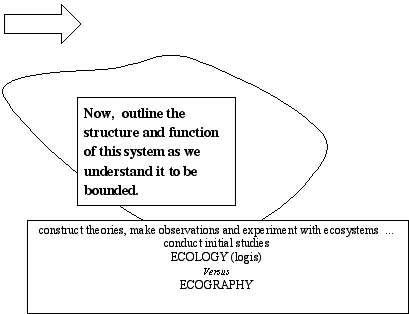
First. Construct the boundaries of any ecological system
Account for space and time variations for what is listed below.