|
|
|
The role of root symbionts in forest migration |
|
PPS ARCTIC
CANADA: An International Polar Year
project on the causes and consequences
of change of the forest-tundra ecotone |
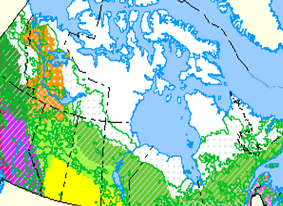
The broad
forest-tundra
ecotone or treeline (mottled
gray on the map) is one of the
largest, most prominent
transitions between ecosystems.
The shift in treeline due to
climate change could have
long-term effects on
biodiversity and on human health
and well-being.
|
 |
|
|
|
Present
day processes, Past
changes and Spatiotemporal
variability of biotic, abiotic
and socio-environmental
conditions and resource
components along and across the
Arctic delimitation zone
in Canada
Linked to the
international PPS Arctic based
in Norway
20
Researchers from more than 10
universities
More
than 20 collaborators
Extensive
community involvement
Over
30 graduate student and 8
postdoctoral projects
|
|
|
|
|
What are the
causes and consequences of
ecosystem change of the
tundra-taiga ecotone?
|
1. To model temporal
and spatial treeline dynamics.
2. To
assess the impact of climate change
on processes within the treeline
ecotone.
3.
To determine
ecosystem services of the treeline
ecotone and their vulnerability with
climate change.
4.
To develop conceptual
models of the relationship of
environmental change and human
health and well-being.
|
 |
|
|
|
|
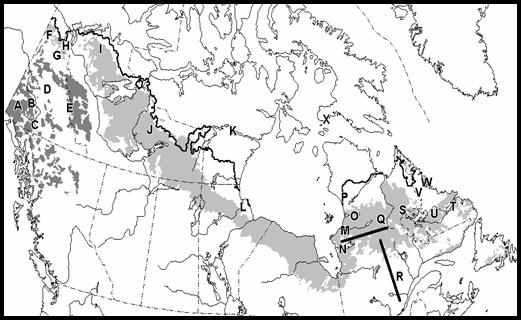
Proposed field
study sites and transects in
relation to arctic treeline
(line), the boreal-tundra
transition forest (light gray),
and the subarctic alpine tundra
(dark gray).
|
|
|
|
|
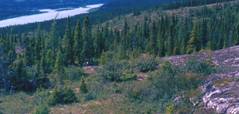
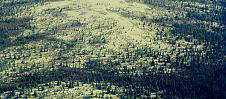
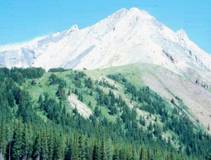
Forest edges
within the forest-tundra ecotone
may be difficult to discern as
tree density can decrease
gradually from dense forest to
scattered trees.
|
 |
|
|
|
|
 |
Scaling up the
effects of climate change on tree
dynamics and biodiversity within the
forest-tundra ecotone is a step
towards preparing for the response
in treeline to climate change.
|
|
|
|
Our project will
potentially provide many
opportunities for graduate
students across the country.
Student projects based in
Halifax include:
1. An assessment
of the relationship
between edge abundance, spatial
configuration and latitude to
predict treeline movement.
(Harper)
2. The role of
soil microbiota in tree
establishment within the
forest-tundra ecotone. (Kernaghan)
3. The potential
effects of treeline expansion on
above and below-ground
communities. (Harper and
Kernaghan)
4. Integration of
the human dimension of
vegetation and landscape change
using repeat photography.
(Harper)
|
|
|
|
|
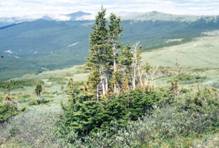 |
The establishment
and growth of tree seedlings may be
influenced by the spatial pattern of
the below ground microbial community
surrounding forest edges.
|
|
|
|
|
Updated September 4th,
2008 - Created and Maintained by Daniel Charbonneau
daniel.charbonneau@msvu.ca
|
|
|
|